
Cortland County Court Records After a Jail Arrest
After an arrest in Cortland County, the custody path usually starts with a sheriff, city police, state police, or local agency action and then, if the person remains held, booking at the Cortland County Jail / Cortland County Correctional Facility. The court-record path begins when an accusatory instrument is filed and the case appears before a court. The District Attorney, currently Patrick A. Perfetti, prosecutes county-level criminal matters from the Cortland County District Attorney's Office, 37 Church Street, Cortland, NY 13045. That prosecutor-filed charge record can differ from the initial arrest or booking reason.
The jail side and the court side answer different questions. Jail inmate records are used to confirm current custody, facility, notification options, and bail-related booking information. Jail mugshots and booking photos depend on what is actually published or released by the agency. Court records after arrest identify the filed charges, the case court, appearance schedule, charge status, and disposition when public access is allowed.
How to Find Cortland County Court Records After an Arrest
The main online criminal-court search channel is NY Courts WebCriminal, which covers selected criminal courts and is designed around pending cases with future appearances. WebCriminal is not the Cortland jail roster and is not a complete criminal-history report. It is the best public online starting point when the question is whether a case has a future court date or visible charge information after a Cortland County arrest.
- Open the NY Courts WebCriminal portal and choose the search path that matches the information available.
- Use Defendant Name when only a person's name is known, or Case Identifier when a docket, case, or summons number is available.
- Use Court Calendar when checking a court part, judge, or appearance calendar for Supreme and County Court matters.
- Read each listed charge, court, appearance date, and status carefully, then compare it with custody information from the jail or VINELink if the person may still be detained.
For felony criminal files, Cortland County's own court-record path is more limited. The County Clerk/Supreme and County Courts page states that felony criminal court files are not searchable through the public record website because they contain confidential information. Unless sealed, felony criminal files can be accessed on a computer terminal in the County Clerk's office. A search request must include the name and time frame, may take up to 24 hours, costs $5 for each two-year period searched, and should include a self-addressed stamped envelope when results are to be mailed.
| WebCriminal Search Field | How It Helps | Cortland Use Note |
|---|---|---|
| Case Identifier | Searches by case number or summons number. | Useful after a clerk, attorney, ticket, or court notice provides the identifier. |
| Defendant Name | Searches by defendant first and last name or corporation name. | Use exact spelling first, then variants if the expected Cortland case does not appear. |
| Court Calendar | Generates calendar information by court, part, or judge where supported. | Helpful for future appearances in Cortland County Court or related covered courts. |
| Court / County | Filters to the relevant court when prompted. | Choose Cortland County, Cortland City Court, County Court, or Supreme Court when available. |
The official WebCriminal landing page notes that some case information can be delayed. If a recent arrest has not produced a visible case record yet, call the relevant court clerk or check again later rather than assuming no case exists.
NY Courts WebCriminal presents the Case Identifier, Defendant Name, and Court Calendar options used for criminal case lookup.
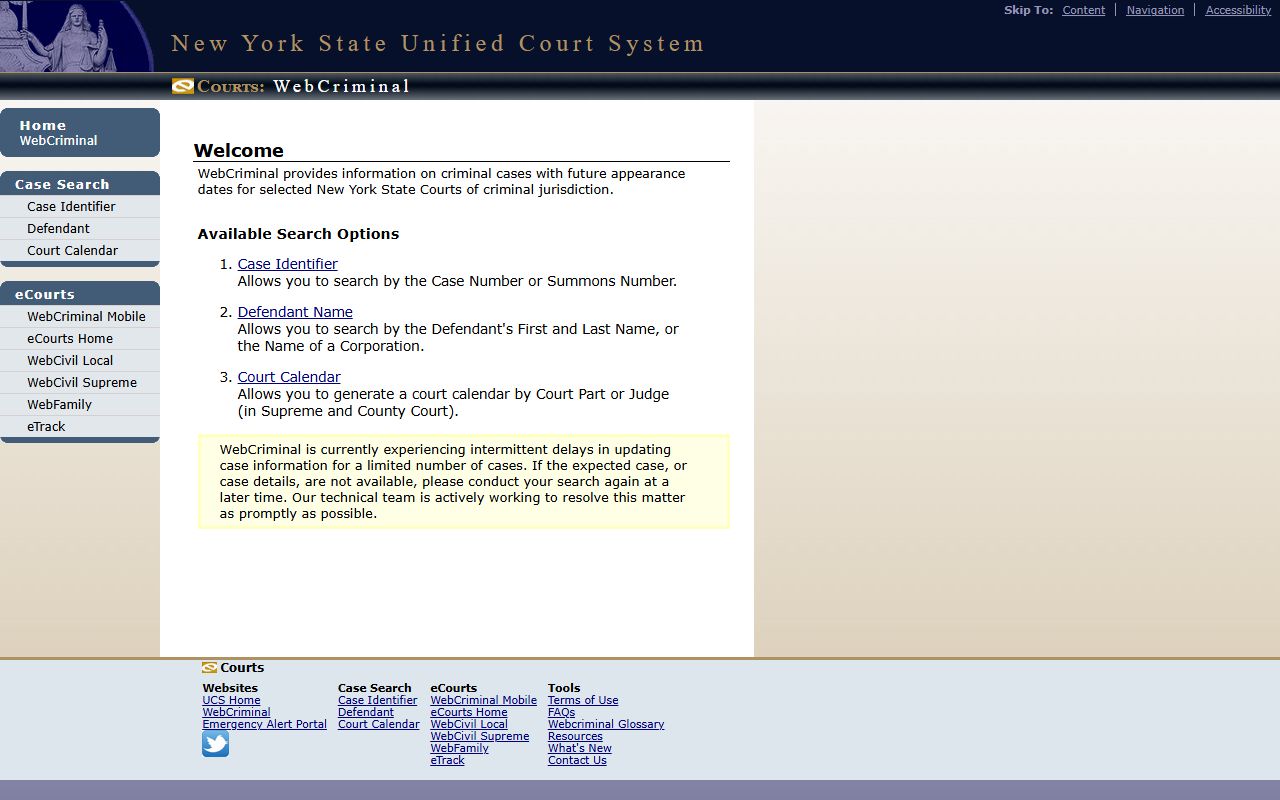
That search screen is useful for court records after arrest, but it should be paired with clerk access for felony files and jail contact for current custody or booking-number questions.
Cortland City Court, County Court, and the Clerk File Path
Cortland City Court handles misdemeanors, lesser offenses, and felony arraignments. Its official page lists 25 Court Street, Cortland, NY 13045, phone 607-218-3300, fax 607-218-3299, and office hours Monday through Friday from 8:30 a.m. to 4:00 p.m. A person arrested in the city may have an early appearance there even if a felony later moves into County Court.
Cortland County Court and Supreme Court are listed at 46 Greenbush Street, Suite 105, Cortland, NY 13045, phone 607-218-3320. County Courts hear criminal matters, and Supreme Court can handle broader civil or criminal jurisdiction as assigned. For felony criminal files, the County Clerk record instructions are especially important because the public SearchIQS-style record site is not the route for those files.
How Charges Get Filed After an Arrest: Complaint, Information, and Indictment
Booking happens at the jail, but the court record after a Cortland County arrest is organized around a charging document. New York Courts describes arraignment as the point where the complaint is read, charges are identified, counsel and bail may be addressed, and a plea is entered. The charge document can start in a lower court and later change as the prosecutor reviews the case, negotiates a plea, presents a felony to a grand jury, or dismisses a count.
| Complaint | Information | Indictment | |
|---|---|---|---|
| Filed By | Usually law enforcement or the prosecutor to begin the accusation. | Prosecutor-supported accusatory instrument used to continue or prosecute the case. | Grand jury accusation used for felony prosecution in superior court. |
| Common For | Arraignment and initial lower-court processing. | Misdemeanors and some continued lower-court matters. | Serious felony cases moving into County Court. |
| Starts | The first court case record after arrest. | The prosecutable charge record in a lower court. | The superior-court felony case after grand-jury action. |
| Cortland Access Point | City Court, town or village court, or WebCriminal if visible. | Relevant lower court or WebCriminal when covered. | County Court and County Clerk felony file access. |
Charge Status in Court Records After an Arrest
Charges can change between booking and disposition. A jail intake entry may reflect the arrest basis, a warrant, or a hold, while the court file reflects what the prosecutor filed and what the court accepted. In Cortland County, that means a VINELink custody result, a bail payment page, a WebCriminal entry, and a County Clerk felony file may all answer different parts of the same arrest event.
| Status | What It Means |
|---|---|
| Pending | The charge or case has not reached final disposition. Future court dates may appear in WebCriminal if the court and case are covered. |
| Amended / Reduced | The filed charge changed, often after prosecutor review, plea negotiation, or court action. The final court charge may be less severe than the booking allegation. |
| Dismissed | The charge ended without conviction on that count. Sealing rules may apply depending on the disposition and New York law. |
| Indicted | A grand jury accused the defendant of a felony, moving the matter toward superior-court prosecution. |
| Convicted | The case ended in a guilty plea or verdict on that charge. It is different from arrest, accusation, or pending status. |
Bond and Release After an Arrest
Bail and release conditions are set through court action, then administered with jail procedures when the person remains in custody. Cortland County's sheriff bail page gives three practical payment routes: the incarcerated person may use available cash funds, another person may post exact cash bail at the Cortland County Correctional Facility, or a credit card payment may be made remotely through GovPayNet or by calling 1-877-EZBAIL5. Third-party cash bail at the jail requires valid photo identification and the exact amount because correction staff cannot make change.
Remote bail requires the defendant's name, date of birth, booking number, court or judge, and cash bail amount. If the booking number is unknown, the sheriff page directs callers to the booking office at 607-756-4275. GovPayNet adds a nonrefundable 8.5 percent fee. The sheriff also warns that remote bail funds become the property of the defendant, and any court refund is made to the defendant rather than necessarily to the person who paid by card.
| Bond Type | How It Works |
|---|---|
| Cash Bail | Paid in the exact amount ordered. At the jail, the payer needs valid photo identification and correction staff cannot issue change. |
| Remote Credit Card Bail | Paid through GovPayNet or 1-877-EZBAIL5 with defendant, booking, court, judge, and bail amount details, plus an 8.5 percent fee. |
| Release on Recognizance or Conditions | The court may release the person without cash bail or with non-monetary conditions, depending on the charge and New York bail rules. |
| Hold or Detainer | Another warrant, parole hold, state-prison transfer, federal matter, immigration detainer, or outside-jurisdiction hold may prevent release. |
Warrants That Lead to an Arrest
The Cortland County Sheriff's Office publishes a Most Wanted page with a type-to-search interface and individual wanted-person entries, but the research did not identify a complete public active-warrant database. Most Wanted entries may include a photo, date posted, date of birth, height, weight, hair, eyes, charges, and a Submit A Tip option. That page is a law-enforcement notice list, not a guarantee that every bench warrant, town-court warrant, or agency warrant is posted.
Bench warrants may originate from Cortland City Court or from town and village courts throughout the county. A warrant can result in arrest, transport to the jail, booking, arraignment, and then a court record or VINELink custody entry if the person remains held. Someone who believes a warrant exists should use the court or attorney route for resolution, not a private database or an incomplete public list.
Charges vs. Convictions
An arrest and a filed charge are accusations. A conviction is a final result after a guilty plea or verdict. Court records after a jail arrest should be read with that distinction in mind, especially when checking an early WebCriminal record or a felony file before disposition.
| Charge | Conviction | |
|---|---|---|
| Stage | Accusation filed after arrest or by later prosecutor action. | Final plea or verdict on a count. |
| Proof Point | Probable cause or accusatory instrument standard at early stages. | Guilty plea or proof beyond a reasonable doubt at trial. |
| Record Meaning | Shows what was alleged and prosecuted, not guilt. | Shows the court's final criminal finding on that count. |
| Can Change? | Yes. Charges may be amended, reduced, added, dismissed, or indicted. | Can be affected by appeal, sealing, or later court order, but it is a disposition. |
Sealed vs. Expunged Arrest Records
New York uses sealing in many criminal-record situations rather than a broad promise that every arrest record is erased. Criminal Procedure Law Section 160.50 seals records after a criminal action terminates in favor of the accused. Criminal Procedure Law Section 720.35 treats youthful-offender adjudications and related official records as confidential. Correction Law Section 9 also affects internet access to certain incarcerated-individual information after statutory periods.
| Sealed | Expunged | |
|---|---|---|
| Visibility | Hidden from most public access, with limited official exceptions. | Destroyed or treated as though it does not exist only where a specific law provides that effect. |
| New York Practice | Common route for favorable terminations and certain confidential categories. | Not the usual label for most New York adult criminal case outcomes. |
| Law Enforcement | May retain limited access depending on the statute and purpose. | Access depends on the specific expungement authority, if any. |
| Eligibility | Depends on disposition, youthful-offender status, statute, and court order. | Depends on a specific statutory remedy, not a general public-record request. |
Background Check Considerations
Casual court lookup is not the same as a regulated employment, tenant, credit, insurance, or licensing background check. NY Courts also identifies formal statewide criminal-history searches through the court system and DCJS fingerprint-based record review for a person's own criminal history. Public case lookup can be incomplete, delayed, restricted, sealed, or limited to cases with future appearances.
Important: Public lookup results are not consumer reports and cannot be used for any FCRA-covered decision.
Restricted Court Records After an Arrest in Cortland County
Not every arrest-related record is public. New York FOIL, Public Officers Law Article 6, starts from public access to agency records but allows exemptions. Court case files are normally requested through the relevant court or clerk rather than through county administrative FOIL. Law-enforcement records may be limited by ongoing investigations, privacy, safety, sealed-case rules, youthful-offender confidentiality, or other statutory protections.
If the arresting agency was Cortland Police, the City of Cortland Police FOIL channel may be the correct path for the police record. If the sheriff created the report, sheriff Civil/Records or the county FOIL process may be the practical route. For felony criminal court files, use the County Clerk instructions, including the $5 two-year search fee, possible 24-hour processing time, and self-addressed stamped envelope for mailed results.